
Leica Geosystems & Schneider Digital: Reality capture becomes a productive 3D workflow

Spatially analysing and processing complex point clouds with Leica Cyclone 3DR and 3D PluraView
Today, reality capture encompasses far more than simply capturing the real world. A seamless workflow is crucial: capturing data from various sensors, merging it, processing it, analysing it and deriving reliable results from it.
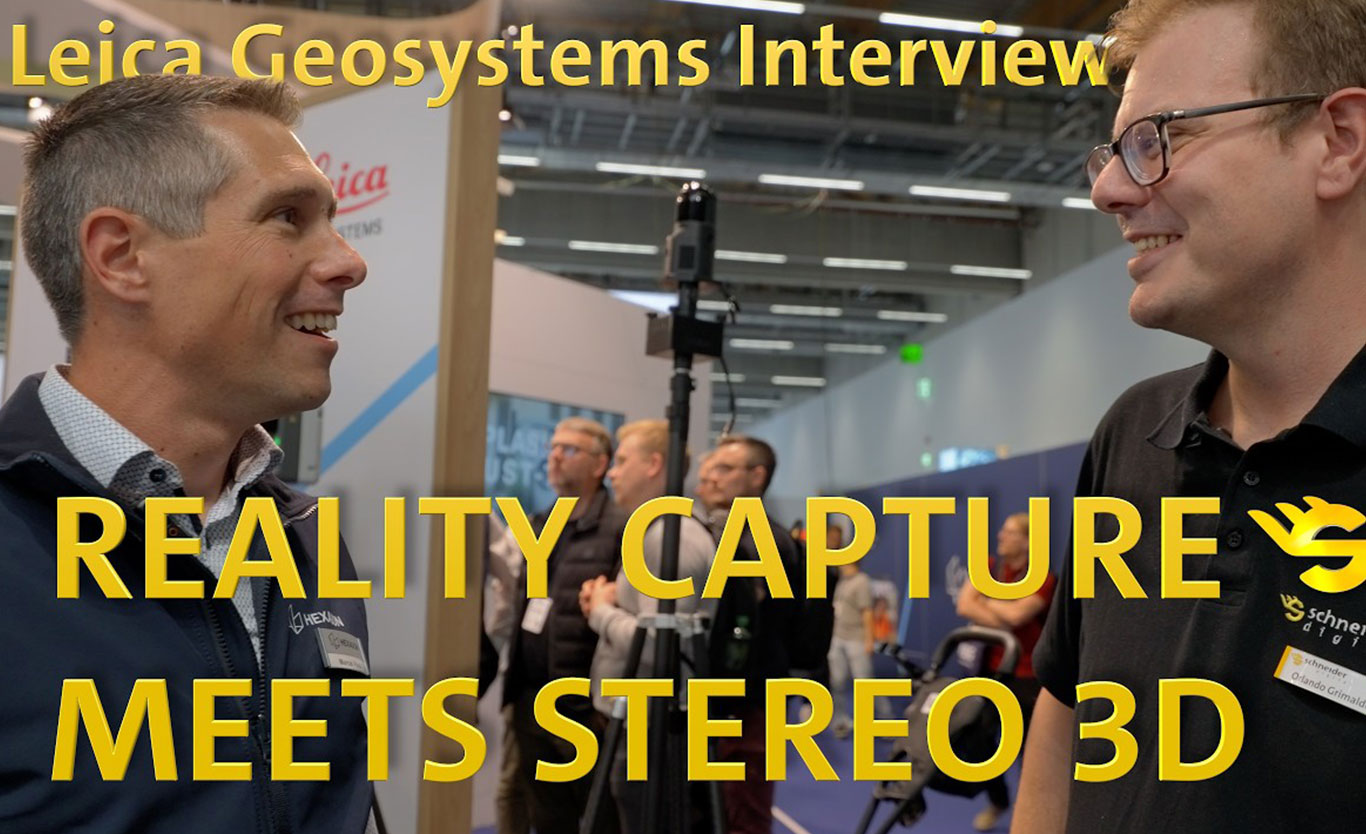
In an interview at INTERGEO 2025, Schneider Digital speaks to Leica Geosystems, part of Hexagon, about this complete process. The focus is on Leica Cyclone 3DR as a software environment for processing and analysing 3D data – and the question of how professional stereoscopic visualisation turns the examination of complex data into a productive 3D workflow.
Reality Capture: From Capture to Analysis
In Leica Cyclone 3DR, data from different sensors can be further processed within a single software environment and used for specific tasks. The applications mentioned in the interview include, for example, volume calculations, target-actual comparisons and the analysis of construction progress.
This transforms the captured point cloud into a tool for surveying, construction, infrastructure, documentation and quality assurance: reality is not only digitally mapped, but is subsequently analysed in a targeted manner.
Don’t just view 3D data – work within it
The workflow becomes particularly interesting when combined with stereoscopic visualisation. Leica Cyclone 3DR supports stereo rendering and, according to Leica’s documentation, has been explicitly tested with the 3D PluraView. Furthermore, a 3D mouse cursor for working within stereoscopic scenes was already integrated into Cyclone 3DR 2024.
This fundamentally changes the way complex point clouds are handled: users not only view a model spatially, but can also navigate directly within the perceived depth and interact with the data.
Precise interaction in spatial depth
A 3D cursor helps users to clearly perceive the position of the mouse pointer within the three-dimensional scene. This enables users to navigate to, select and examine objects and areas at the correct spatial depth. An impressive 3D visualisation is thus transformed into a practical workspace for analysis and editing.
This is precisely where a key strength of the combination of software and passive 3D stereo hardware lies: when both systems are consistently designed for spatial work, complex 3D data becomes more intuitively accessible and workflows become more efficient.
- Complete reality capture workflows
- Data acquisition using various sensors
- Processing and analysis of complex 3D data
- Leica Cyclone 3DR as the central software environment
- Volume calculations and target-actual comparisons
- Analysis and documentation of construction progress
- Stereoscopic work with point clouds
- 3D cursor for precise interaction in spatial depth
- Interaction between professional software and 3D hardware
When software and hardware speak the same language
The interview makes it clear: the added value of professional 3D technology does not stem solely from powerful software or a high-performance monitor. The key lies in their interaction. When reality capture data, analysis functions and stereoscopic visualisation merge into a single workflow, users can capture complex spatial information more quickly and edit it in a more targeted manner.
Outlook: The next level of professional 3D workflows
Schneider Digital is consistently developing this approach further. Alongside 3D PluraView and 3D GlobeView, the company’s own software solutions for stereoscopic and immersive working environments – such as ImmersaXR-Studio and StereoVista – are increasingly taking centre stage. At INTERGEO 2026, which took place from 15 to 17 September in Munich, Hall B5, Stand K036, Schneider Digital presented this expanded hardware and software portfolio together for the first time.
Enable 3D stereo with Leica Cyclone 3DR
Schneider Digital How-to 3D-Stereo